


High-Load Platforms in Australia: How to Select AS-Standard Stair Treads?

Selecting the right Stair Treads is crucial for ensuring safety and compliance in high-load environments. Australia's industrial platform safety standard, AS 1657, outlines specific load requirements that stair treads must meet. Using ordinary stair treads in these settings poses significant risks. For instance, non-compliant treads can lead to injuries such assprains, strains, fractures, and even fatalities. It is essential to choose Australian Standard Stair Treads, particularly our High-Load Steel Grating options, to mitigate these dangers effectively. Additionally, our range includes Galvanized Railings that provide enhanced safety and durability. For optimal performance, we also offer Hot-Dip Galvanized Steel Grating and FORGE WELDED STEEL GRATING, ensuring that all products meet the highest standards of quality and compliance.
Key Takeaways
- Selecting AS-standard stair treads is essential for safety in high-load environments. Compliance with AS 1657 reduces the risk of injuries.
- Evaluate load requirements and material options carefully. Steel Grating and fiberglass are strong choices that offer durability and slip resistance.
- Regular inspections and maintenance routines are crucial. Frequent checks help identify wear and ensure ongoing safety.
- Consider design features like visibility and nosings. These elements enhance safety by preventing trips and falls.
- Consult professionals for tailored advice. Their expertise can guide you in making informed decisions about stair tread selection.
Overview of AS Standards
When I delve into the Australian Standard (AS) standards, particularly AS 1657, I find a comprehensive framework designed to ensure safety in high-load environments. This standard outlines essential requirements for stair treads, which play a critical role in preventing accidents. Here are the key requirements I consider when selecting stair treads:
- Stair treads must be slip resistant.
- Treads should extend across the full width of the stairway.
- The edges of the treads must be visible against the background.
- Slip-resistant nosings can be added to meet standards.
- Treads must be solid if the stairway exceeds 10 metres in height or connects more than three stories.
AS 1657 stands out from other international standards due to its rigorous testing protocols. It specifies that stair treads must undergo testing with a load of 1–1.5kN, depending on the width of the staircase. This ensures that the treads do not flex excessively under load, which is crucial for safety. Additionally, the entire staircase assembly must withstand a load of 2.5kPa, equivalent to approximately 250kg. This requirement guarantees stability and safety during use.
Moreover, AS 1657 takes a comprehensive approach by considering additional design loads, such as those from wind or snow. It references AS/NZS 1170.2 and AS 1170.3, ensuring that all potential load factors are accounted for in the design of stair treads.
To verify compliance with these standards, specific testing methods are outlined. Here’s a summary of the steps involved:
| Step | Description |
|---|---|
| (a) | Apply a loading of not less than 2.5 kPa uniformly distributed on each tread and landing for a period of not less than 5 minutes. |
| (b) | Measure and record the midspan deflection of the underside of the centre tread and the centre of supporting landings under the test load, with a maximum permitted deflection of L/200. |
| (c) | Remove the test load and inspect all welds for signs of weld cracking or other signs of failure. |
Understanding these standards helps me appreciate the importance of selecting Australian Standard Stair Treads. They not only ensure compliance but also enhance safety in high-load environments.
Selecting Australian Standard Stair Treads
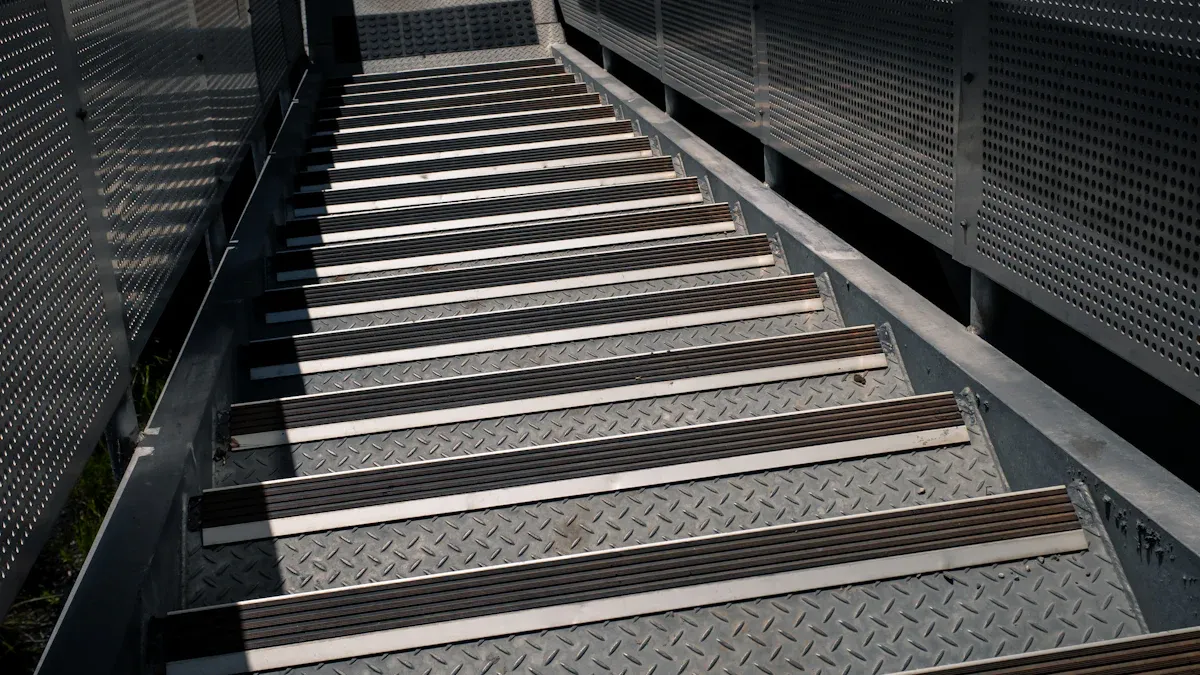
When I select Australian Standard Stair Treads, I focus on several key factors to ensure safety and compliance. The right choice can significantly reduce the risk of accidents in high-load environments. Here are the steps I take during the selection process:
-
Assess Load Requirements: I begin by determining the specific load requirements for the environment. This includes understanding the maximum weight the stair treads will need to support. I refer to AS 1657 to ensure that the treads can handle the necessary loads without flexing or failing.
-
Evaluate Material Options: I consider the materials used in the stair treads. Steel grating is often my preferred choice due to its strength and durability. I also look for options that offer slip resistance, which is crucial for safety.
-
Check for Compliance: I always verify that the stair treads meet the Australian standards. This includes checking for third-party certifications. Certifications like NSF/ANSI 332 demonstrate a manufacturer's commitment to sustainability. They provide me with confidence that the products meet established criteria for safety and performance. This level of assurance is vital when making informed choices in a market filled with various claims.
-
Consider Design Features: I pay attention to design features such as nosings and visibility. The edges of the treads should be clearly visible against the background to prevent trips and falls. Additionally, I ensure that the treads extend across the full width of the stairway for maximum safety.
-
Review Installation Guidelines: I also look into the installation guidelines provided by the manufacturer. Proper installation is essential for the performance of the stair treads. I ensure that the installation process adheres to the specifications outlined in AS 1657.
-
Seek Professional Advice: Finally, I do not hesitate to consult with professionals if I have any doubts. Their expertise can guide me in selecting the most suitable stair treads for my specific needs.
By following these steps, I can confidently select Australian Standard Stair Treads that enhance safety and comply with regulations. This careful selection process not only protects users but also contributes to the overall integrity of high-load platforms.
Key Considerations for High-Load Platforms

When I consider high-load platforms, several key factors come to mind. These factors significantly influence the safety and effectiveness of stair treads in these environments.
-
Traffic Volume: The expected traffic volume on a platform heavily influences my choice of stair treads. High traffic levels require materials with greater strength and load capacity. I ensure that the treads can withstand the anticipated wear and tear, which is crucial for maintaining safety and durability.
-
Anti-Slip Features: Non-slip stair treads are essential for preventing slips and falls in high-traffic industrial areas. I look for treads designed to withstand extreme conditions, making them ideal for environments exposed to oil, water, and chemicals. Here are some recommended anti-slip features:
Feature Description Durability ComposiGrip™ is made from high-strength composite materials, resistant to wear, corrosion, and chemicals. Traction Provides excellent traction on various surfaces including steel, concrete, and wood. Visibility Ecoglo® glow-in-the-dark stair nosings enhance visibility during low-light conditions. Compliance Helps maintain compliance with OSHA standards. Installation & Maintenance Quick to install and low-maintenance, suitable for high-load environments. -
Maintenance Requirements: I recognise that maintenance directly impacts the long-term performance of stair treads on high-load platforms. Regular upkeep prevents deterioration, ensuring safety and extending the lifespan of the treads. For example, traditional materials like steel and aluminium require frequent maintenance to combat corrosion and wear. In contrast, I find that fiberglass reinforced plastic (FRP) offers superior durability and lower maintenance needs. This results in reduced lifecycle costs and enhanced safety due to its slip-resistant properties.
-
Environmental Conditions: I also consider the specific environmental conditions where the stair treads will be installed. Factors such as exposure to chemicals, moisture, and temperature fluctuations can affect the material choice. I ensure that the selected treads can withstand these conditions without compromising safety.
By keeping these considerations in mind, I can make informed decisions when selecting stair treads for high-load platforms. This approach not only enhances safety but also contributes to the overall integrity of the structure.
Technical Parameters of AS-Standard Stair Treads
When I explore the technical parameters of Australian Standard Stair Treads, I focus on several critical specifications that ensure safety and compliance. Understanding these parameters helps me select the right treads for high-load platforms.
First, I consider the dimensions and tolerances. The following table outlines the standard specifications for stair treads:
| Dimension/Tolerance | Specification |
|---|---|
| Minimum rise (R) | 150 mm |
| Maximum rise (R) | 225 mm |
| Minimum going (G) | 175 mm |
| Maximum going (G) | 355 mm |
| Tread surface width | Full effective width of stairway |
| Slip resistance | Required |
| Vertical clearance | 1850 mm |
| Uniformity tolerance | ±5 mm (prefabricated), ±10 mm (site-constructed) |
| Landing length | 400 mm |
| Landing width | Width of stairway |
Next, I examine the recommended surface finishes for compliance with AS 1657. The following table summarises these requirements:
| Requirement | Description |
|---|---|
| Slip-resistant finish | All treads and top nosing must have a slip-resistant finish or a non-slip strip system near the edge of each tread nosing. |
| Surface classification | Treads must have a surface with a slip-resistance classification not less than that listed in Table 3.9.1.3 when tested in accordance with AS 4586. |
I also consider the materials used for stair treads. Fiberglass stair treads stand out due to their superior slip resistance, boasting a Coefficient of Friction (COF) of 0.65 when wet. This performance significantly exceeds OSHA's minimum requirement. In contrast, steel treads often lead to higher slip incidents. For instance, a petrochemical facility reported a 42% reduction in slip reports after switching to fiberglass. Additionally, fiberglass treads support a live load of 3.0 kN/m² with a verified deflection limit under ASTM standards. They also absorb impact energy three times more effectively than mild steel, making them a robust choice for high-load environments.
By understanding these technical parameters, I can confidently select Australian Standard Stair Treads that meet safety requirements and enhance performance in demanding settings.
Practical Implementation Tips
When I implement AS-standard stair treads, I focus on several practical tips to ensure safety and compliance over time. Here are some strategies I find effective:
-
Regular Inspections: I make it a habit to inspect stair treads frequently. This helps me identify any wear or damage early. I pay special attention to the nosings, as they often collect grit and can become slippery.
-
Maintenance Routines: I follow specific maintenance routines to keep the treads compliant. Here’s a summary of the tasks I perform:
Maintenance Task Description Carpet I vacuum frequently, focusing on nosings where grit collects. I spot clean with the correct solution for the fibre. Tile I sweep and use a pH-neutral cleaner. I refresh grout lines as needed. Metal and Glass I use appropriate glass cleaner and non-abrasive cloths. For metal, I follow the manufacturer’s corrosion care advice. Long-Term Maintenance I reseal wood as needed. High-traffic areas might need an extra coat every few years. Many prefinished products allow light screen-and-recoat without full sanding. I also inspect for loose treads or nosings, tightening fasteners and re-gluing as necessary. For exterior steps, I reapply non-slip coatings and clear debris that traps moisture. Prevention and Safety I maintain textures and finishes that meet traction needs. I consider clear non-slip additives in topcoats. -
Proper Installation: I ensure that the installation of stair treads follows the guidelines outlined in AS 1657. This includes checking that the treads extend across the full width of the stairway and that the edges are visible against the background.
-
Training for Users: I believe in educating users about the importance of using the stair treads correctly. I encourage them to report any issues they notice, such as loose treads or slippery surfaces.
By following these practical implementation tips, I can maintain the safety and compliance of AS-standard stair treads effectively. This proactive approach not only protects users but also extends the lifespan of the stair treads in high-load environments.
Selecting AS-standard stair treads is vital for ensuring safety and compliance in high-load environments. These treads not only enhance safety but also offer long-term benefits. For instance, I find that durable stair nose strips can save time and money by allowing for easy replacements rather than full tread replacements.
Non-slip stair treads are a critical investment. They reduce workplace injuries, lower liability, and create safer environments for everyone.
I encourage you to prioritise safety and compliance in your projects. Consulting professionals can provide tailored advice and solutions that meet your specific needs. Your commitment to safety will pay off in the long run.
About Jiulong
Ningbo Jiulong Machinery Manufacturing Co., Ltd (NJMM) was founded in 1993, is mainly engaged in the design and manufacturing of steel grating, railings, platforms and other light steel structures. It is a modern comprehensive enterprise integrating scientific research and design, machinery manufacturing and engineering construction.
We currently have 2 production bases in the East and North of China, there are 12 steel grating auto welding product lines, as well as complete auxiliary processing equipment and testing facilities, like robots welding, laser cutting, digital control panel tailoring etc. Our annual output of steel gratings and allied products, including trench covers, stair treads, stanchions, handrails, fences, is over 50,000 metric tons.
NJMM offers engineering service and support, including the design and installation of the grating solutions and the provision of detailed drawings if required. NJMM is committed to a continuous process to enhance customer service through product quality and delivery. NJMM had got the ISO9001 Quality System Certificate, CE certificate, GHOST certificate and other international certificates.
We believe our products are your best choice.
Enterprise culture
Company Vision
To be the leader in steel grating market, the preferred supplier & A good corporate citizen..
Enterprise Mission
To provide the top quality products & services with global expertise; To build a harmonious envirnment for employ- ees growing together with the company; To contribute to the advancement of both industry & society.
FAQ
What are AS-standard stair treads?
AS-standard stair treads comply with Australia's safety standards, specifically AS 1657. They ensure safety in high-load environments by providing slip resistance and structural integrity.
How do I know if my stair treads meet AS standards?
I check for third-party certifications and compliance documentation. Manufacturers often provide this information, confirming that their products meet AS 1657 requirements.
Can I install stair treads myself?
While I can install stair treads, I recommend hiring professionals. Proper installation ensures compliance with safety standards and maximises the treads' effectiveness.
What materials are best for high-load stair treads?
I prefer steel grating and fiberglass reinforced plastic (FRP) for high-load stair treads. Both materials offer strength, durability, and slip resistance, making them ideal for demanding environments.
How often should I inspect stair treads?
I recommend inspecting stair treads regularly, at least once a month. Frequent checks help identify wear or damage early, ensuring ongoing safety and compliance.
